
6 Low-Cost Technologies That Are Changing Indian Agriculture

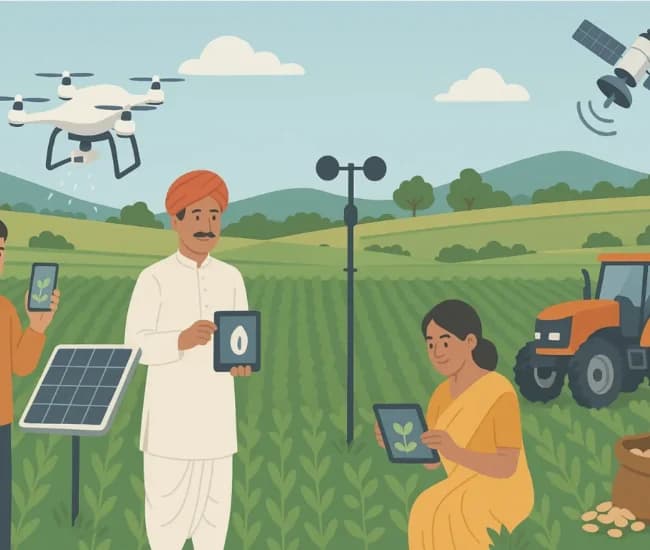



6 Low-Cost Technologies That Are Changing Indian Agriculture
Soil Testing Kits Improve Nutrient Management
Mobile Agriculture Apps Support Real-Time Decision Making
Micro-Irrigation Brings Water Precision to Small Farms
Solar-Powered Cold Storage Reduces Post-Harvest Loss
Affordable Farm Mechanization Fills the Labor Gap
IoT Sensors Enable Precision with Simple Devices
Government and NGO Support Fuel Tech Access
The Agriculture Seeds Producer Company
Mon - Sat: 10:00 - 18:00
The agricultural sector in India is undergoing a quiet revolution, propelled not by massive industrial operations but rather by accessible and reasonably priced technology that are changing the way smallholder farmers operate. These tools enhance yields, boost efficiency, and aid in climate uncertainty adaptation in addition to lowering operating costs.
Small and marginal landholdings are used by more than 85% of Indian farmers. Productivity has been hampered by traditional issues, including unpredictable rains, an excessive reliance on manual labour, and restricted access to market knowledge. However, inexpensive technology designed for Indian circumstances are closing the gap.
Farmers are receiving affordable gadgets that solve actual field issues thanks to government programmes and innovative startups. The future of Indian agriculture is being redefined by these advances, which range from post-harvest cold storage to soil health management.
Yield potential is determined by the health of the soil. However, typical lab-based testing takes a lot of time and is frequently unavailable to rural farmers. This is resolved by portable soil testing kits that provide immediate, on-site nutrient readings.
Farmers can use colorimetric kits to evaluate micronutrients, pH, and NPK levels through straightforward chemical reactions. These kits save weeks of waiting for lab results and can be purchased for as little as ₹300 to ₹1000.
This technology helps farmers:
Based on these quick tests, the Ministry of Agriculture encourages the use of soil health cards to inform fertilisation strategies. Access is gradually growing as kits are increasingly incorporated into workshops at the village level and Krishi Vigyan Kendras.
Smartphones have transformed rural communication. Now, mobile apps are bringing agronomic advice, mandi prices, and pest alerts directly to farmers’ hands.
These apps are becoming essential tools for making decisions in rural India, where 70% of people own smartphones. Farmers utilising mobile agri apps have observed a 25% decrease in input waste and improved crop timing based on weather data.
Certain apps even facilitate peer-to-peer conversations, establishing online communities for knowledge exchange. These instruments provide smallholders more autonomy and less reliance on regional middlemen.
One such success story came from Chhattisgarh, where a farmer saved ₹14,000 per season by following mandi rate alerts and selling produce in nearby towns rather than through local aggregators.
In Indian agriculture, water stress is a constant threat. More than 52% of arable land depends on erratic rainfall. Drip and micro-irrigation systems provide solutions that improve yields while conserving water.
Low-cost kits that use emitters, flow regulators, and polyethylene pipes to distribute water straight to plant roots start at ₹2,500 for 1-acre setups. These systems:
Many farmers have access to this technology at reduced costs because to subsidy programmes under the Pradhan Mantri Krishi Sinchayee Yojana (PMKSY). Mass adoption has occurred in states like Andhra Pradesh and Maharashtra.
The adoption of Vertical Farming is also gaining traction in peri-urban zones. This method combines micro-irrigation with controlled environments, allowing soil-less farming that uses up to 90% less water than traditional agriculture.
Post-harvest spoiling costs India ₹92,000 crore a year. Farmers lack access to cold storage, particularly those who cultivate perishables like spinach and tomatoes. This is being changed by solar-powered cold storage devices.
To keep vegetables fresh off-grid, these machines use solar panels, battery backups, and insulated chambers. With capacities ranging from 500 kg to 2 tonnes, startups like Ecozen and Tan90 provide cold storage for between ₹30,000 and ₹1.5 lakh.
They help:
Tamil Nadu farmers said they are now preserving jasmine blooms for an additional 3 days to take advantage in higher festival rates. To maximise benefit and minimise individual investment, farmer-producer groups frequently co-own these systems.
“Technology in agriculture isn’t about complexity, it’s about relevance, accessibility, and timing.” — Sunita Narayan, environmentalist
Farm inefficiencies and increased labour costs are the results of rural labour migration. Large tractors and harvesters are neither suitable nor cheap for smallholders. This is being resolved by low-cost mechanisation, such as weed.
Products such as:
allow farmers to automate soil preparation, planting, and harvesting with no training. These devices are small, fuel-efficient, and made for plots of one to two acres.
Machine rentals are available at custom hiring centres (CHCs) operated by NGOs and cooperatives for as little as ₹150 to ₹500 per hour. This concept expands access without placing a burden on ownership.
According to a 2022 Indian Council of Agricultural Research (ICAR) research, mechanised farms outperformed manual ones in terms of efficiency by 21% and input costs by 17%.
Precision farming is no longer just for large farms. Affordable IoT sensors and data dashboards are now being deployed in Indian villages. These devices monitor:
Costing between ₹1,000 and ₹3,500, wireless sensors are installed in the field and linked to cloud dashboards via LoRaWAN gateways. Smartphone messages about when to fertilise or irrigate are sent to farmers.
The connected farming model is growing, especially among Farmer Producer Organizations (FPOs), which scale the solution across member plots.
For more insight, this precision agriculture guide outlines global trends and their adaptation to Indian farming.
Tech adoption isn’t possible without financing and support. The Indian government, along with NGOs, is facilitating tech reach through schemes, subsidies, and training.
Major initiatives include:
Additionally, NGOs facilitate training, trial projects, and the distribution of subsidised kits for solar pumps or soil testing. Under Kisan Credit Card (KCC) programmes, farmers can also take advantage of zero-interest loans.
These initiatives lower the cost barrier and boost confidence in new technologies.
Agrinnovate India, which monitors current programmes and financing sources, offers more policy breakdowns.
In Maharashtra’s Yavatmal district, farmer Ramesh Pawar installed a ₹3,000 drip irrigation kit on his cotton field. His water usage dropped by 48%, and yield rose by 38%. He reinvested savings into seed drills.
In Bihar, Meena Devi, a member of a local SHG, used a ₹350 soil test kit. She identified a potassium deficiency and adjusted her fertilizer use, increasing rice yield by 20% while cutting input costs by ₹2,000.
In Andhra Pradesh, a farmer group rented a solar cold storage unit for ₹500/day during the tomato harvest season. Their spoilage dropped from 22% to under 5%, allowing them to supply to larger urban retailers.
These stories show how small, actionable tech steps result in measurable benefits.
Despite the advantages, there is still opposition to digital use. Financial disparities, inadequate infrastructure, and low digital literacy remain obstacles.
App usage is restricted by mobile internet reliability and rural broadband. Due to inadequate training or subpar after-sales support, many farmers mistrust untested equipment.
Another obstacle is cost perception; even inexpensive tools appear costly in the absence of finance or subsidies. Additionally, Tier 3 regions lack qualified experts for diagnosis and repairs.
Emerging innovations will drive the next phase of agri transformation in India:
Startups and research institutions like ICAR and IITs are investing in open-source agri platforms that reduce R&D costs and increase scalability.
Future innovations will be even more data-driven, interoperable, and tailored for smallholder needs.
India’s agriculture is moving from risk to resilience as small farmers adopt smart instruments. Reliability, cost, and impact are more important than complexity. The majority of Indian farming takes place in low-connectivity areas, on small plots, and under budgetary constraints, hence these technologies will be the ones of the future.
+919978829143
Visit Our Multi Vendor Marketplace
© 2026 AgriBee Seeds Pvt Ltd.